

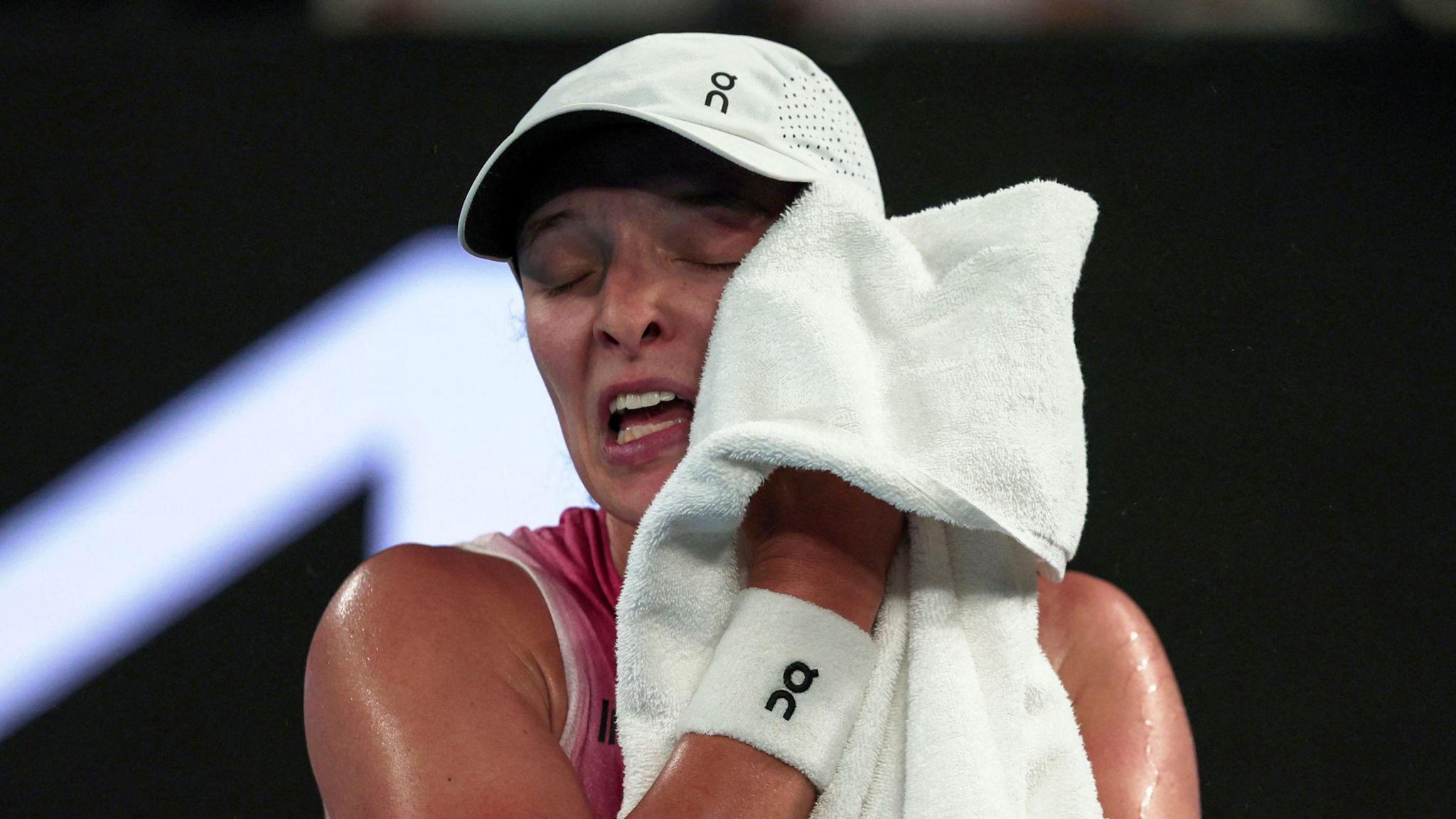
Wimbledon champion Iga Swiatek commented in September that she considers the season is "too long and too intense."
After Daria Kasatkina concluded her 2025 season prematurely in October, the ex-top ten player explained how she had "encountered a barrier."
"The calendar is overwhelming. Mentally and emotionally I'm at breaking point, and, unfortunately, I'm not alone," she stated.
Ukraine's Elina Svitolina, a two-time Wimbledon semi-finalist, had earlier revealed she was not in "the mental space" to carry on, while reigning Grand Slam champions Iga Swiatek and Carlos Alcaraz additionally believe the calendar is overly extended.
The topic is still being argued as the world's top tennis players reconvene in Australia for the start of the 2026 season.
A slightly longer off-season than 2025 has been welcomed. Nonetheless, several weeks is not regarded as sufficient time for thorough recovery before training starts for an 11-month campaign seen as among the most onerous in professional sport.
"Tennis places greater strain on athletes now than it ever has," commented Dr. Robby Sikka, chief medical officer at the Professional Tennis Players' Association (PTPA).
"Matches and rallies are longer, players are faster, they're hitting the ball harder.
"It is our obligation to shield the competitors and give them a more viable sport."
So what is being done and what additional measures could be enacted?
Condensing the Tour Schedule
The 2025 season covered 47 weeks for many players on the ATP circuit, starting with the United Cup team event in late December 2024 and concluding with the Davis Cup final in late November.
The WTA Tour season concluded two weeks earlier when the WTA Finals finished in early November. The ITF moved the Billie Jean King Cup Finals forward to September to alleviate scheduling concerns.
The ATP Tour says it does not take the concerns of the players "lightly," while the women's tour asserts player welfare will "consistently be the foremost concern."
That failed to satisfy the PTPA, which initiated a lawsuit against the men's and women's tours in March, citing "unfair practices and a clear neglect of athlete well-being."
Restructuring the calendar is an apparent fix but cannot be achieved easily given the complicated structure of tennis governance, where the four Grand Slams, ATP, WTA, and ITF each have major stakes.
"It is crucial to evaluate whether we can reclaim time at the end of the year for an longer break, or can we allow for a pause during the season so there is a brief respite," said Dr. Sikka.
Former world number one Andy Roddick, a long-time advocate for change, says the season should not go past 1 November.
The ATP Tour has decreased the number of events which count towards the rankings for 2026, which it thinks will reduce "the cumulative strain" on the players.
"One point that often gets overlooked: players determine their own playing calendar," remarked ATP chairman Andrea Gaudenzi.
"Such autonomy is uncommon in elite athletics. But with that comes accountability - recognizing the right time to play and the right time to heal."
Extending several mandatory tournaments across a fortnight - creating so-called 'super weeks' - has also been questioned.
"I believe competitors are more worn out mentally and physically because they're away from home for extended periods," opined Britain's former men's world number one, Andy Murray.
In addition to mental burnout, there are worries about the increased physical demands.
Players suffer more severe upper-body injuries in specific periods, according to player association statistics.
The organization says these "anticipated spikes" are down to the seasonal itinerary and the switches in court surfaces.
Minimizing Midnight Matches & Uniform Balls
When a memorable contest at the Australian Open finished in the early hours in 2023, it was expected to drive reform.
In 2024, the tours introduced a new rule stopping matches beginning past 11pm.
But there have still been instances of matches finishing well past midnight - which medical experts insist.
"After a match concludes, an athlete's day isn't over," added Dr. Sikka.
"You have to do media, recover, work with the physiotherapist. Your day extends well beyond the match.
"Your body, brain and nerves don't have chance to recover. There is no other sport which mandates that."
Data suggests a player is significantly more prone to be injured during a night-session match.
A lack of standardization in tournament equipment - leading to changes in weight and pace - has been pointed to as a source of a rise in upper body injuries.
"I have suffered numerous arm, shoulder, and wrist issues," said one top British player, "and such ailments are increasingly prevalent among peers."
A former US Open champion, who ended his career last year with an ongoing wrist injury, thinks tournaments in the same seasonal segment should use one uniform ball.
"It shouldn't be too difficult - the same ball for clay, the same for hard and the same for grass. That would be really helpful to the players," he said.
The tours moved towards a more standardized equipment policy during 2025 and anticipate "complete uniformity" in the coming years.
Learn from NFL & Protect Young Players
Athletic performance experts believe tennis must take cues from how American team sports use data to guide the welfare of its stars.
Based on data-led analysis, the NFL demanded consistent playing surfaces and improved helmet technology to lessen the risk of injury.
"American football has implemented numerous reforms driven by data," said an analytics expert whose firm provides data to monitor player welfare.
"We've seen the economic model is skyrocketing because their games are so competitive and they're maintaining a healthy roster.
"They are investing heavily in their stated goals by protecting athletes and devoting significant resources – that model is the exemplar."
Other leagues have introduced rules aimed at protecting pitchers, limiting their throws at the professional level and putting guidelines for juniors.
Some retired players believe the strain put on the upper body of tennis players from a tender age is a significant factor in their injuries later on.
"Training begins in childhood and have so many countless swings of our groundstrokes," said the former champion.
"Over time, the wrist suffers the consequences. Way more players have problems with the wrist. I think the problem is the many, many repetitions."
Competitors Seek Adjustments - What Are the Key Issues?
An increasing number of players are speaking out about the demands placed on them.
Current world number ones are among a collection of elite athletes increasing demands on the Grand Slams with calls for a increased portion of tournament income, as well as genuine dialogue about the length of the season, extended events and match timing.
Last year, a top-ten American player said it was "ridiculous" he was only able to take one week off before the next campaign.
Sympathy can be in short supply, though, given top players also participate in lucrative non-tour contests.
One Grand Slam champion from Britain says the relentless travel is a "challenge" but thinks top players "criticizing the calendar" is not a good look.
"{Uniform


